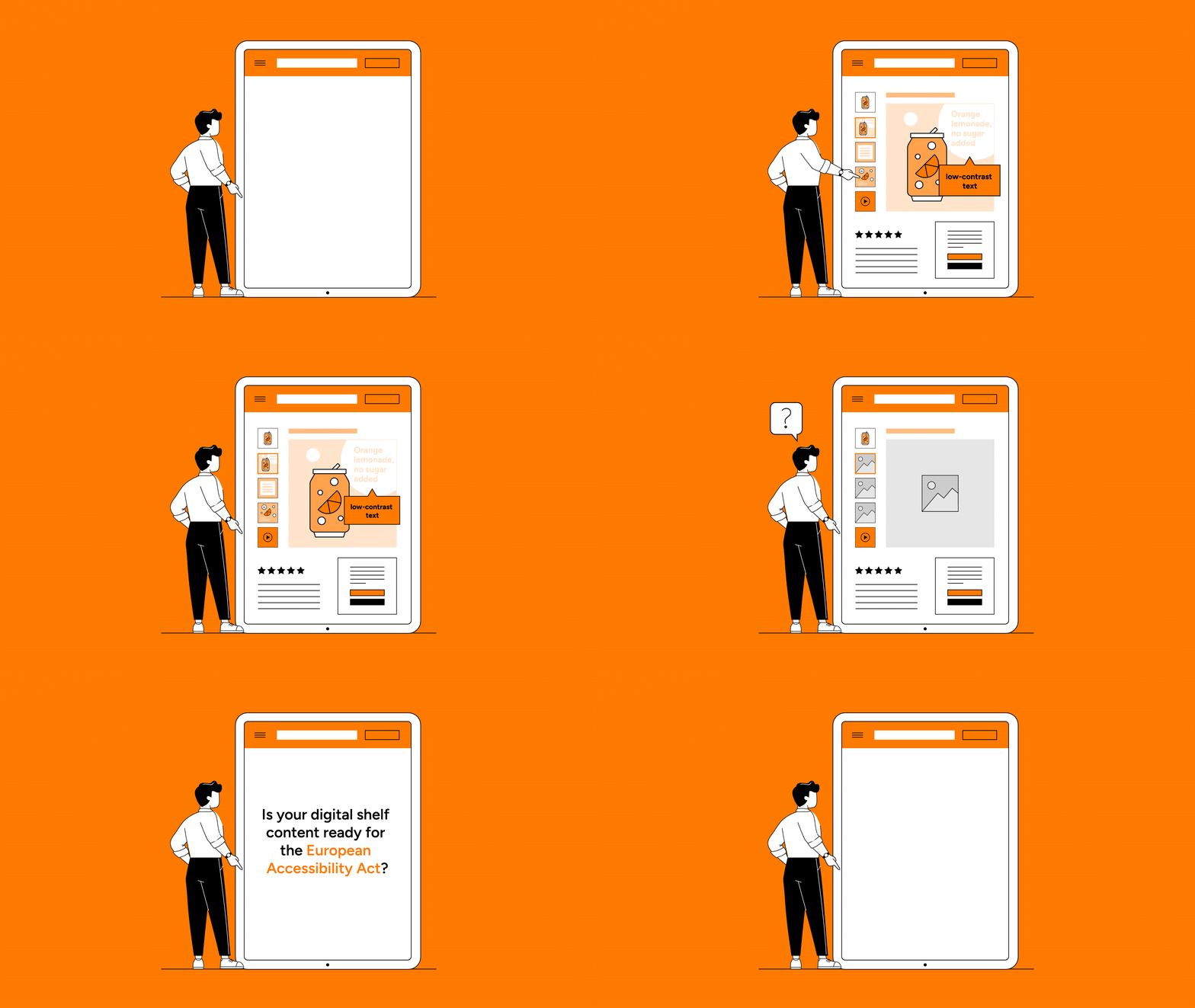
The European Accessibility Act (EAA) has been in force since June 2025. The harmonised technical standard that defines how compliance will be assessed, known as EN 301 549, is expected to be published in July 2026. Once published, enforcement authorities across EU member states will have a clear framework for taking action, and retailers will have a basis for assessing whether the product imagery on their websites exposes them to litigation risk.
Webinar Highlights Reel:
On 29 April 2026, eStoreBrands hosted a live webinar on the EAA's implications for brands and retailers, featuring Oliver Bradley from Neem and Dr Sam Waller from the University of Cambridge. Oliver chaired the GS1 industry working group that created global standards for accessible eCommerce imagery and has built Rhino, an automated accessibility testing tool. Sam wrote the section on adequate text size within the European standard that interprets the EAA.
Following the webinar, we asked attendees to submit any further questions they wanted answered. Oliver Bradley and Dr Sam Waller have responded to each one. We have published their answers as a dedicated FAQ covering scope, enforcement, text size and contrast requirements, grace periods, and more.


What does the European Accessibility Act require for eCommerce?
The EAA (EU Directive 2019/882) applies to any eCommerce services delivered to EU citizens through websites or mobile devices. The scope, as written into the Act, covers anything that "has a view to concluding a consumer contract." In practical terms, this means product pages, shopping carts, checkout flows, support channels, and the imagery within them.
The Act requires that text and images of text are presented at "adequate size and sufficient contrast" in order to maximise usability for people with disabilities. Around 101 million people in the EU, roughly one in four over the age of 16, have a disability. Research suggests that a significant proportion of major eCommerce sites still do not meet accessibility requirements.
The geographic scope is broad. Any retailer that delivers to EU citizens is in scope, regardless of where the retailer is based. As Sam Waller noted during the webinar, Amazon UK delivers to Ireland, which means everything on the Amazon UK website falls within scope. The same applies to any UK or non-EU retailer that ships to EU destinations.
Which eCommerce content is in scope?

One of the most valuable aspects of the webinar was the detailed breakdown of exactly which types of eCommerce content are likely to be covered by the EAA and which are probably exempt. The picture is more nuanced than many brands may expect.
Primary images (pack shots): Probably exempt. The text on a photograph of the front of pack is considered essential to the information being conveyed. Adjusting the text size or contrast would mean it was no longer a photograph of the pack. The same logic applies to any image where the text is an inherent part of the scene being depicted.
Secondary images with off-pack text: In scope. If a secondary image includes text that is not part of the physical pack (claims, feature callouts, promotional messaging), there is no reason it would be exempt from the size and contrast requirements. This text could have been made larger or higher contrast without changing the nature of the image.
Secondary images with zoomed-in back-of-pack content: Likely in scope. If an ingredients list or nutrition information has been extracted from the pack and presented as a standalone secondary image, it could and should have been reformatted and resized to maximise readability. Simply photographing the back of pack in close-up does not satisfy the requirement.
A-plus content: In scope, and potentially a significant issue. A-plus content is often designed for desktop and then compressed to fit mobile screens, at which point the text can become extremely small. Sam flagged this as an area where widespread non-compliance is likely.
Media and banner adverts: Likely in scope if they include pricing information or a purchasing call to action, as they would be considered to have a view to concluding a consumer contract.
Brand.com websites: Likely in scope, particularly any pages with buy-now buttons or other direct purchasing functionality. The further a page is from a transaction (sustainability claims, about us), the more uncertain the position becomes. The lowest-risk approach is to ensure the entire site is compliant.
Byline text: An unresolved area. Making legally required byline text (such as regulatory disclaimers) fully compliant with the minimum text size could render the image impractical. Sam proposed that 50% of the minimum compliant size may be a reasonable compromise for byline text, but acknowledged this needs industry-wide agreement and may require a dedicated working group to resolve.
What are the consequences of non-compliance?
During the webinar, Sam explained that Neem invested in specialist legal advice from accessibility law firm Stevens and Bolton to understand the legal landscape. The firm identified three levels of consequence for EAA litigation.
The first is reputational damage. Being named in an EAA lawsuit creates negative publicity regardless of the outcome. The second is administrative overhead: the staff time and cost of responding to compliance proceedings. The third is financial: fines for non-compliance, plus the cost of remedial action, with fines continuing until the remediation is complete.
As Sam put it, brands face the cost of getting it right either way. The choice is between doing it proactively or being fined and then having to do it anyway.
Enforcement is already underway in some markets. Oliver highlighted that web accessibility lawsuits have already been brought against major French retailers including Leclerc and Carrefour, with fines of up to 250,000 euros. He also noted that enforcement authorities are targeting the most obvious issues first: poor contrast and inadequate font sizes.
Will retailers act to remove images before they get fined?
This was arguably the most important insight from the webinar. As the economic operator of the eCommerce service, the retailer is the party directly exposed to EAA litigation risk, not the brand supplying the product imagery. This changes the dynamics significantly.
As soon as retailers realise that secondary images, A-plus content, or media adverts on their platforms may expose them to litigation, they are likely to take that content down. Sam and Oliver both emphasised that retailers are exceptionally risk averse. If a retailer is uncertain whether an image is compliant, the likely response is to remove it rather than investigate further.
This means that for most brands, the immediate risk is not a fine. It is having product imagery removed from retailer websites, potentially overnight. Oliver predicted that most of the beauty category will have imagery removed from Amazon by August 2026 because the prevalence of low-contrast text and small font sizes in beauty content is particularly high.
When asked about the grace period brands can expect from retailers, Sam's response was blunt: brands should count their grace period in hours, not months. Once retailers are made aware that images may expose them to litigation risk, the response will be swift.
The practical implication for brands is clear. The priority is not to avoid fines. It is to convince retailers that your images are compliant and should be kept live. This requires evidence, not assertions.
What are the specific requirements for text size and contrast?
Text size: The current draft of EN 301 549 implies that adequate size means images of text should have an x-height (the height of a lowercase letter such as 'a' or 'e') of at least 2.4 millimetres when displayed at a reference size of 60 millimetres (the approximate width of a secondary image shown full-width on an iPhone SE). For live HTML text on websites, the requirement is less stringent at 1.2 millimetres, because the text can be resized by the user.
Sam wrote the text size requirements in the standard and confirmed these figures during the webinar. The publication date for the finalised standard is currently scheduled for 22 July 2026, though he noted this could slip.
Contrast: The standard references a contrast ratio of at least 3:1, derived from ISO 9241, a standard originally written in 1992. Sam was candid about the limitations of this measure, demonstrating during the webinar that the contrast ratio frequently produces incorrect results on modern screens. He advocated for the Advanced Perceptual Contrast Algorithm (APCA), which uses contrast difference rather than contrast ratio and aligns more accurately with how text is actually perceived.
Sam notes there is clear evidence that WCAG 2 contrast ratio doesn't work, it has no empirical or theoretical evidence to support its use on mobile devices, and APCA is better.
Sam endeavours to get APCA formally recognised as an Alternative Method of Compliance for the European accessibility act, and Sam aims to convince retailers to use APCA to determine whether images get taken down.
Nevertheless, at the current time, only the contrast ratio pass is guaranteed as ‘presumed legally compliant with EAA’. There is an unresolved legal question: if content fails the contrast ratio test but passes the APCA test, what is the EAA compliance position? Until such time as there is a guaranteed answer to this question, and a guaranteed answer to the criteria that retailers will use to decide which images they live, Oli advises brands to ensure their colours pass both tests.
How can brands test their content for EAA compliance?
Manual testing is possible using tools like Contrast Tools, which supports both WCAG 2 and APCA testing. However, manual testing does not scale. Oliver estimated that testing a single simple hero image takes around three minutes, while a secondary image with multiple text elements takes around five minutes.
For a typical large CPG brand with 150,000 PDP secondary images across multiple retailers, manual testing would take approximately three and a half years. With the standard expected to be published in July 2026, there are roughly three months available.

Oliver and Sam's solution to this scaling challenge is Rhino, an automated accessibility testing tool built by Neem and powered by Cambridge's visual clarity research. Rhino can assess both contrast (using WCAG 2 and APCA) and text size (using Cambridge's experimental data on x-height and capital letter equivalence) across large volumes of images. It produces PDF compliance reports that can be shared with retailers as evidence that images should remain live.
For brands exploring their options, the Neem website has further information on Rhino's capabilities.
What should brands do now?
Based on the webinar discussion, brands selling through online retailers in the EU should consider the following steps ahead of the expected publication of EN 301 549 in July 2026.
Audit your secondary images first. This is where the highest volume of non-compliant content is likely to sit, and where retailer takedown risk is greatest. Focus on off-pack text: claims, feature callouts, promotional messaging. On-pack text within primary images is probably exempt.
Assess your A-plus content on mobile. Content designed for desktop that is then compressed for mobile screens frequently falls below the minimum text size requirements. Check how your A-plus content renders on a small mobile device.
Review your agency contracts. Oliver's advice was direct: if EAA compliance is not in your agency contract, revise it. If your agency is producing content that is non-compliant, they are exposing you to the risk of having content removed from retailers across the EU.
Test against both contrast standards. Use the WCAG 2 contrast ratio (because it is in the legal standard) and the APCA (because it is more accurate). Avoid colour combinations that fail either test.
Prepare evidence for retailers. When retailers begin assessing compliance, brands that can demonstrate their content has been tested and meets the requirements will be in a stronger position than those that cannot. This is about having documented evidence, not verbal assurances.
Consider the competitive advantage. If your content remains live while your competitors' content is taken down, the commercial benefit could be considerable. Brands that act early will be better positioned when enforcement begins.

As Sam summarised: "If you can do something to make your content more accessible, then you should. And if the content can't be made accessible, then you should still do the best you can."
Or, more concisely: be furiously single-minded.
Frequently asked questions
What is the European Accessibility Act? The EAA (EU Directive 2019/882) is an EU law requiring that key products and services, including eCommerce, are accessible to people with disabilities. It has been in force since June 2025.
When will the technical standard for EAA compliance be published? The harmonised standard EN 301 549 is currently scheduled for publication on 22 July 2026, though this date could slip. Once published, it will provide the specific criteria against which compliance will be assessed.
Does the EAA apply to UK retailers? It applies to any retailer that delivers to EU citizens, regardless of where the retailer is based. UK retailers that deliver to Ireland or other EU countries are in scope.
Are primary product images (pack shots) in scope? Probably not. The text on a photograph of the pack is considered essential to the information being conveyed and is likely exempt from the size and contrast requirements.
Are secondary images in scope? Off-pack text within secondary images is likely in scope. This includes claims, feature callouts, and promotional messaging. On-pack text within secondary images (such as a photograph of the back of pack) is probably exempt.
What is the minimum text size for EAA compliance? The current draft standard implies an x-height of at least 2.4 millimetres for images of text (measured at a reference display size of 60 millimetres) and 1.2 millimetres for live HTML text on websites.
What is the contrast requirement? The standard references a contrast ratio of at least 3:1 (WCAG 2). However, the APCA contrast algorithm is considered more accurate for modern screens. Testing against both is recommended.
Will brands be fined for non-compliance? Brands supplying product imagery are not the primary target of EAA enforcement. The retailer, as the economic operator of the eCommerce service, is directly exposed. However, retailers will likely remove non-compliant imagery rather than risk litigation, which means brands face the risk of content takedown rather than direct fines.
What is the grace period for compliance? There is no formal grace period. The EAA has been in force since June 2025, and the draft standard has been publicly available for several months. Retailers are expected to act quickly once the published standard provides a clear compliance benchmark.