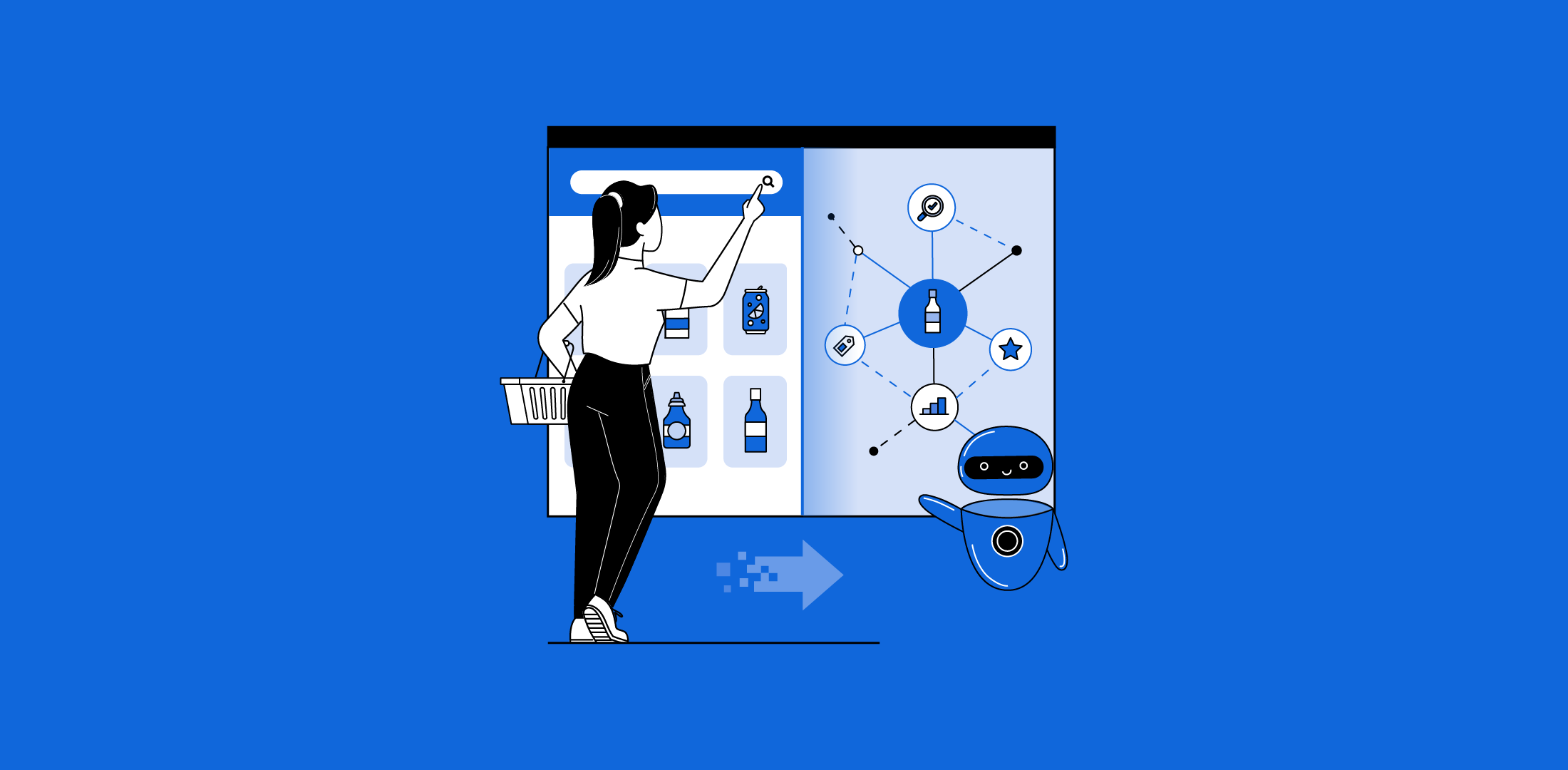
This year, three of us from eStore went to Shoptalk Europe in Barcelona: myself, David Halls (our VP Sales) and Joe Gall (one of our Commercial Directors). There were multiple themes, but one that really stood out was AI. Sessions which touched on this included how retailers are restructuring their operations to how AI agents are beginning to do the shopping themselves.
On the flight home, the same point kept coming back to us. Underneath all the AI talk, what actually separated brands was something far less exciting: the quality and structure of their product data. The ones that looked ready for an agent-led shelf had done the boring work first.
We can group the what we heard regarding AI into three themes. This piece sets out each one, and what it means for how brands manage the digital shelf.
The digital shelf is becoming an algorithmic surface
The common thread across sessions was that discovery is moving away from human search towards algorithmic and conversational surfaces. In the session on navigating rapid AI adoption, speakers from Euromonitor and Merkle put numbers to it:
“conversational AI is predicted to account for around a quarter of business-to-consumer commerce by 2030, with roughly $780 billion in AI-influenced sales by 2029.”

Several speakers described AI as retail's new front door. It influences choice, though not always conversion. Amazon is evolving Alexa into a shopping agent, whilst restricting external AI platforms from accessing its marketplace. Walmart, Tesco and Carrefour are each building or partnering around their own AI ecosystems. Europe was described as leading on AI discovery but lagging on commercialisation, held back by regulatory friction around GDPR and the AI Act.
Once an algorithm sits between your product and the shopper, a brand needs to see what that algorithm sees. The eStore platform tracks visibility, search and content across more than 3,000 retailers in over 70 markets. On AI specifically, we monitor Amazon's shopping assistant, recently renamed Alexa for Shopping though many brands still know it as Rufus.
AI's clearest returns are in operations, not the storefront
The most convincing AI stories in Barcelona were operational, not customer-facing. The Czech online grocer Rohlik reported around €24 million in annual savings from AI-driven dynamic pricing, cutting food waste from an industry norm of 2 to 3 per cent to under half a per cent. Swedish fashion retailer Gina Tricot described a 10 per cent uplift from using AI to delay stock allocation until demand patterns emerged.. Nestlé shared that its internal tool reduced administrative work for sales teams by 30 to 40 per cent.
This matches how we think about AI in the eStore platform. We use it where it removes manual effort for the operator. AI Business Answers and the Insights Copilot turn a large dataset into a plain answer in seconds, so an eCommerce manager spends less time working through dashboards and more time acting on what they find.
"The brands winning conversations with us are not the ones with the biggest AI ambitions. They are the ones who realise an agent will only ever be as good as the product data it reads. That is a far more practical place to start."
David Halls, VP Sales, eStore
Top Actions is a good example of where we have chosen not to use AI. It tells a user the handful of things most likely to affect sales today, and it is rules-based and auditable. There is no model guessing inside it. When a brand asks why an action has been recommended, we can show the rule that produced it. We try to be clear about where AI helps and where it does not.

AI agents are 'boring shoppers' that reward clean data
The phrase from the sessions that stuck with all three of us was that agents are "boring shoppers." They do not respond to a strong hero image or a clever campaign. They read structured product data and represent what they find. In the session on getting seen in the age of AI commerce, Mondelez described sourcing up to 30 citations per answer, with around 35 per cent of those sources coming from earned media and retailer product pages. Douglas noted that AI search is still under 1 per cent of its traffic, but its commercial impact is growing quickly.
Every gap, inconsistency or error in your product content is now read literally by something shopping on your behalf. Getting seen is shifting from search engine optimisation towards answer engine optimisation, where accurate, enriched, machine-readable content does the work.
This is the part of the conversation closest to what we do. If agents represent what they read, then the accuracy of that data carries real commercial weight. The eStore platform runs at 99.7 per cent data accuracy, which matters more when something is reading that data literally rather than a person interpreting it.
Content Optimizer addresses the enrichment problem itself. It optimises a product page in one step against competitiveness, search visibility, AEO visibility and brand guidelines. That is the boring, structural work the agent-ready brands in Barcelona had already done.
Joe Gall made the point on the way back that almost every brand we spoke to on the floor knew they had a data quality problem. Very few had a way to measure it.

Where this leaves brands
A few things felt clearer by the end of the week. Human-facing dashboards no longer describe how products are actually being found, so brands need a view of what the algorithm sees. The data has to come before the agent, because chasing visibility on conversational platforms is wasted effort when the underlying product content is thin or wrong. And content has become infrastructure rather than campaign. It needs to be accurate, structured and maintained, not refreshed once and left.
It is unglamorous groundwork, and it decides whether a brand is represented well when an agent does the shopping.
What we are focused on
Several things moved up our list as a result of the trip. We monitor Alexa for Shopping (formerly known as Rufus) today and are working towards broader AI-search visibility. Content Optimizer continues to develop against AEO visibility, since that is where so much of the Barcelona conversation landed. And we keep extending verified retailer coverage where partnerships allow, because verified data is a stronger foundation than monitored estimates when an agent is reading it literally.
We would not claim to have every part of this solved. The standards for AI visibility are still settling across the industry, and our thinking will move as the field's thinking moves. The direction, though, looks clear to us. AI is moving faster than most brands' data is ready for, and the advantage is going to the brands that treat product data as infrastructure.
If you would like to see what an algorithm sees on your digital shelf, we can walk you and your team through it on the platform. Book a walkthrough.
References and Further Reading
- The Portman Group - UK alcohol industry self-regulation and labelling guidance
- Drinkaware - responsible drinking guidance and consumer research
- IWSR Drinks Market Analysis - European alcohol ecommerce and no/low forecasts
- Rabobank Beverage Research - online alcohol marketplace and product page analysis
Francis Nicholas, VP of Product
June 2026