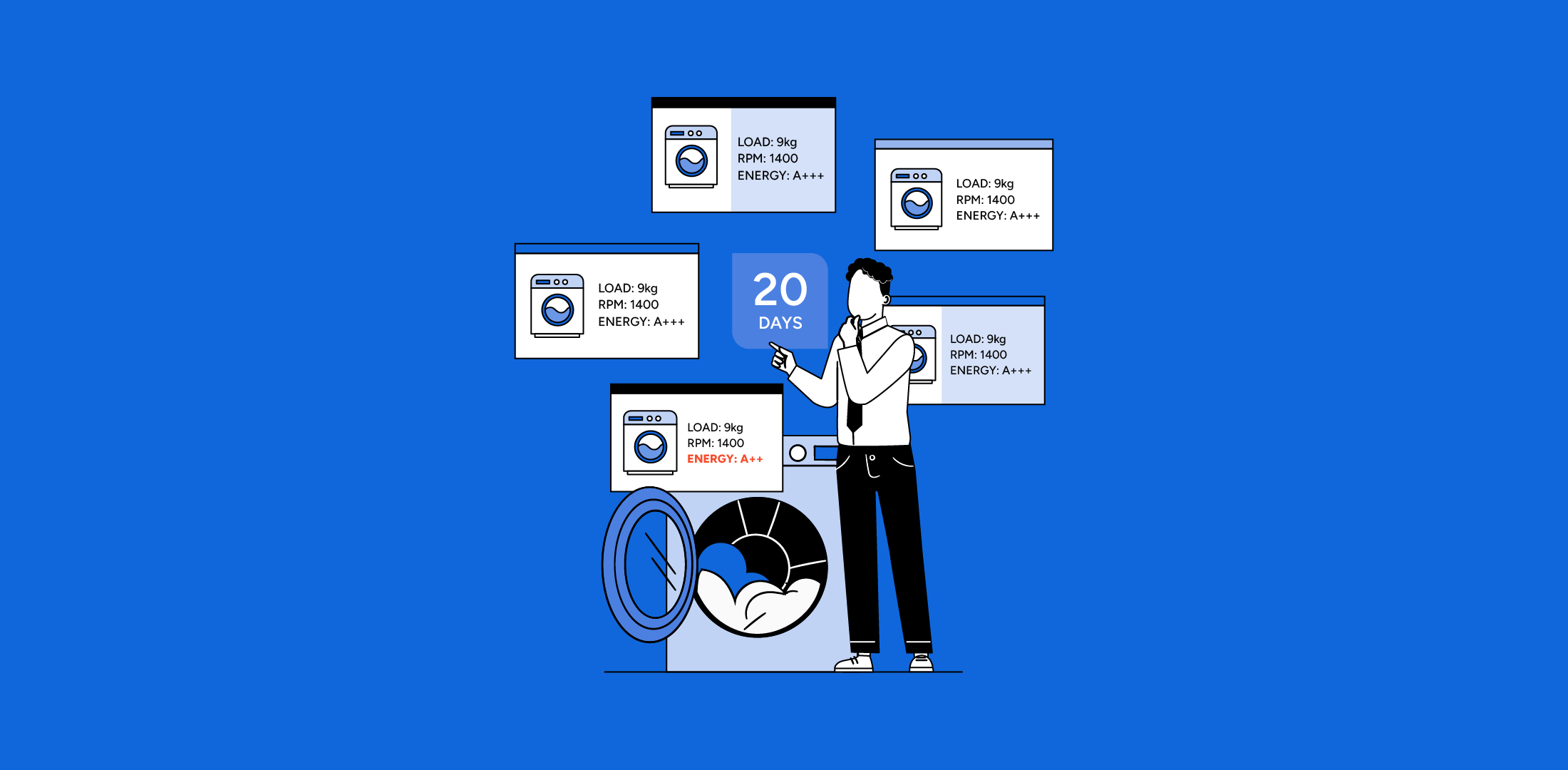
An electronics purchase takes time. Criteo (2018) puts the average gap between first product page view and purchase at around 20 days, and for the slowest quarter of buyers it stretches to 49. The shopper spends that time comparing, reading the same product on one retailer site after another, and increasingly handing the job to an AI assistant that reads the same pages in minutes. Every one of those readings is a chance for your listings to contradict each other. The pages have to agree.
In short: Consumer electronics has one of the longest consideration cycles and lowest conversion rates in ecommerce, because shoppers compare the same product across multiple retailers before committing. Every inconsistency between those pages, in specifications, imagery, pricing or availability, is visible in a way no other category makes visible. AI shopping assistants compress that comparison from weeks to minutes and are less forgiving of messy data than the humans they act for. Cross-retailer consistency is vital for building consumer trust.
Table of Contents
- Why does an electronics purchase take time?
- What does the comparison shopper see that you do not?
- How do AI shopping assistants change the comparison?
- Where does consistency pay back?
- What this means for your digital shelf strategy
Why does an electronics purchase take time?
Because the purchase is expensive, the specifications matter, and the product is identical wherever it is bought. A shopper choosing between two washing machines or two laptops gains nothing by deciding quickly and loses nothing by checking one more retailer. So they check.
The numbers describe a category built on hesitation. Criteo found the average electronics shopper takes around 20 days from first product page view to purchase, with the slowest quarter of buyers taking 49 days and the fastest converting in around half an hour. TripleWhale's 2025 benchmarks put electronics conversion at 1.58% of site visitors, against 2.73% for food and beverage. Long cycles and low conversion are not a failure of the category. They are how considered purchases behave.

For a brand, the consequence is that your product is not encountered once. Over those weeks the same shopper may read your listing on MediaMarkt, Amazon, Currys and Fnac, plus a comparison site aggregating all of them. Each page was built by a different route: a syndication feed here, a retailer content team there, a distributor upload somewhere else.
A shopper comparing five retailer pages is reading one product from five angles.
What does the comparison shopper see that you do not?
Discrepancies. A wattage that differs between two retailers. A dimension quoted in centimetres on one page and inches, wrongly converted, on another. Last year's hero image alongside this year's. A feature listed at one retailer and absent from the spec table at the next. Any one of these is minor. Read side by side, they raise the question every considered purchase is trying to close down: which page is right?
Most brands never see this view, because internal reporting is organised by retailers. Each listing is checked against its own template and passes. Nobody is checking the listings against each other, and the shopper is the first person to read them that way.
The category makes this worse than elsewhere because electronics specifications are pass-or-fail purchase criteria. A shopper who cannot resolve whether the drive fits their bay or the hub supports their standard does not buy the ambiguous product. They buy the one whose story is held together, or they buy nothing today and restart the comparison next week.
How do AI shopping assistants change the comparison?
On the surface, they run the same comparison in minutes. A shopper who once opened five tabs now asks an assistant to compare quiet dishwashers under 45 decibels, and the assistant reads the retailer listings, reconciles the specifications and returns a shortlist. Amazon reports that shoppers who engage with its assistant are 60% more likely to complete a purchase, and European retailers are building their own assistants on the same logic, something we have written about separately on Ignite.

What the assistant has not earned - yet - is trust. A shortlist arrives with no working shown, and shoppers know it. So the recommendation becomes a starting point rather than a decision: the shopper opens the suggested products and looks for evidence the assistant cannot manufacture. Usually that means other buyers. Ratings and reviews carry the authenticity an opaque recommendation lacks, and a recommended product with thin or poor reviews can lose the sale the assistant set up for it.
The reader of your listings has still changed, though. A human weighing two pages with conflicting wattages might shrug and trust the retailer they know. An assistant reconciling structured data has no loyalty to spend. Where your product's data is inconsistent or incomplete, the safest move available to it is to recommend the product whose data is clean, and it makes that move without telling anyone.
None of this is a reason to rebuild your strategy around AI. The listings the assistants read are the same ones the humans read, and the reviews that authenticate a recommendation are the same ones that reassure a shopper arriving on their own. The work of keeping data consistent and reviews healthy across retailers is the same work it has always been. The tolerance for getting it wrong is what has narrowed.
A human shopper might forgive a discrepancy between two pages. An assistant simply recommends something else.
Where does consistency pay back?
Three places. Conversion first: in a category declining at 1.58%, the brand whose product tells the same story on every page is removing the cheapest objection there is. The shopper's remaining doubts should be about the product, not about which page to believe.
Returns second. Electronics returns cluster around compatibility and expectation mismatch rather than preference, and a listing that overstates, understates or misquotes a specification anywhere in the retail estate is manufacturing them. In a category where average order values are high, each avoided return is worth more than most content fixes cost.

Third, the assistants and the reviews that back them up. Retailer AI environments build their answers from listing data, and shoppers verify those answers against ratings and reviews, so the consistency work that converts human comparison shoppers is the same work that keeps you both recommendable and believable as more of the comparison is delegated. Our platform tracks ratings and reviews across your retail estate alongside how products surface in Alexa for Shopping, with coverage of further retailer AI environments following as retailers launch them.
Seeing all of this needs the shopper's view rather than the retailer-by-retailer one. Competitive benchmarking shows how your listings compare across retailers and against the category on the signals comparison shoppers weigh, and Content Optimizer brings brand targets, category benchmarks and retailer field requirements together so the same specification reads the same way everywhere it appears.
What this means for your digital shelf strategy
The long consideration cycle is not a problem to fix. It is how your category buys, and it is becoming a comparison your shoppers increasingly delegate. Both versions of that journey are decided by the same thing: whether your product's data holds together when read across every page that carries it.
Doing this across markets and retailers depends on accurate, current data. The eStore platform delivers 99.7% data accuracy across more than 3,000 retailer websites in over 70 markets, so you can see your products the way a comparison shopper sees them, and catch the discrepancy before it costs a sale or a recommendation.
For the full picture on specification management, seasonal compression and platform selection in this category, read the complete guide to digital shelf analytics for consumer electronics brands.
Key Takeaways
- Criteo puts the average electronics purchase at around 20 days from first product page view, with the same product compared across multiple retailers along the way, and the category converts at 1.58% against 2.73% for food and beverage.
- Internal reporting checks each listing against its own template, so cross-retailer discrepancies in specifications, imagery and pricing are usually seen first by the shopper.
- Specifications are pass-or-fail purchase criteria in this category, and a shopper who cannot resolve a conflict between two pages tends to buy the product whose story held together.
- AI shopping assistants run the comparison in minutes from the same listing data and reconcile conflicts by recommending the product with the cleaner data, but their shortlists arrive with no reasoning shown, so shoppers verify them against ratings and reviews. Amazon reports shoppers who engage with its assistant are 60% more likely to complete a purchase.
- Consistency pays back in conversion, in avoided returns, and in staying recommendable inside retailer AI environments. The eStore platform provides 99.7% data accuracy across more than 3,000 retailer websites.
Frequently Asked Questions
Why do consumer electronics shoppers take so long to buy?
Because the purchases are expensive, specification-driven and identical across retailers, so there is no cost to checking one more page. Criteo puts the average at around 20 days from first product view to purchase, with the slowest quarter of buyers taking 49 days, and electronics converts at roughly half the rate of faster-moving categories.
What do comparison shoppers notice that brands miss?
Discrepancies between retailers: a specification that differs between two pages, outdated imagery alongside current, a feature present in one spec table and missing from another. Brand reporting is usually organised by retailer, so each listing passes its own check and nobody reads them side by side until the shopper does.
How do AI shopping assistants affect electronics brands?
They compress the multi-retailer comparison into minutes, working from the same listing data humans read, and where that data conflicts an assistant tends to recommend the product whose data is clean and complete. Shoppers then verify the recommendation against ratings and reviews, because an assistant's shortlist shows no working. Winning both takes the same cross-retailer consistency work, plus healthy reviews wherever the product is sold.
Does cross-retailer consistency actually affect returns?
In electronics, returns cluster around compatibility and expectation mismatch rather than preference. A specification that is overstated or misquoted on any retailer page sets an expectation the product will not meet, and with high average order values, each return avoided is worth more than most content corrections cost.
Turn Discovery Into Commercial Advantage
If you lead ecommerce or category for a consumer electronics brand and want to see your products the way a comparison shopper, or their assistant, sees them across European retailers, we would welcome the chance to walk through how it works. Speak to our team for a detailed look at cross-retailer monitoring and benchmarking for your portfolio.
References and Further Reading
- Criteo, "Consumer Electronics Trends: Key Insights from H2 2024" - path-to-purchase duration: around 20 days on average, 49 days for the slowest quarter of buyers
- Triple Whale, "Ecommerce Benchmarks 2025" - category conversion rates, including Consumer Electronics at 1.58% and Food & Beverage at 2.73%
- Fortune, "Amazon says its AI shopping assistant Rufus is so effective it's on pace to pull in an extra $10 billion in sales" (November 2025) - the 60% purchase completion figure from Amazon's Q3 earnings call
- Corso, "Electronics Returns: What Every Seller Needs to Know" - electronics return rates and drivers