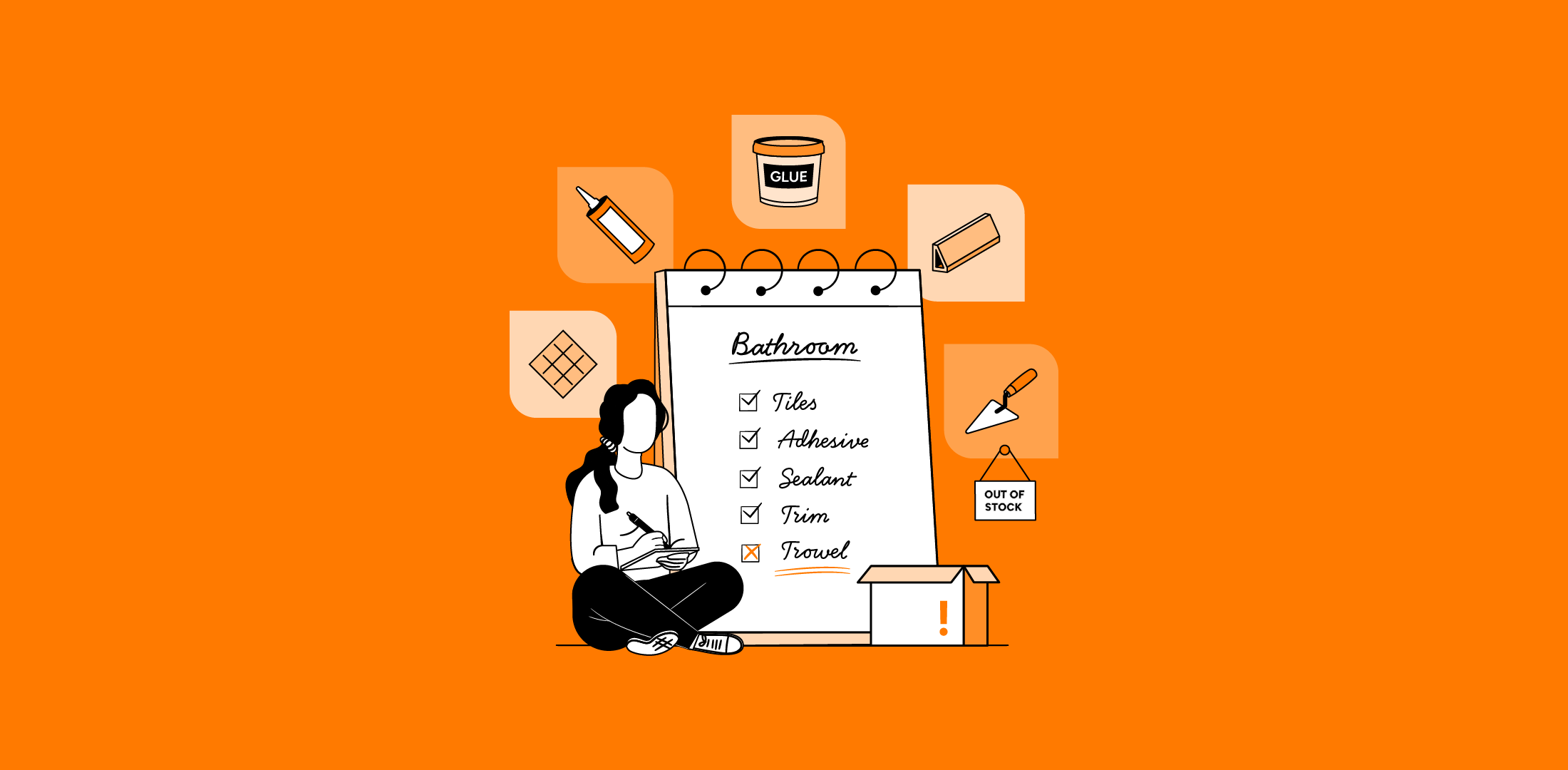
Behind most Home & DIY purchases sits a project, and behind the project sits a list: the tiles, the adhesive, the grout, the trim, the tool that makes the rest usable. Every brand in the category knows this. Almost no brand's availability data reflects it, and the gap between how shoppers buy and how brands measure is where whole projects go missing.
In short: Home & DIY purchases arrive as baskets of complementary products, and one unavailable item can move the entire basket to another retailer, taking sales of in-stock products with it. None of that is news to brands in the category. What most measurement misses is the cost. SKU-level reporting records the products that left with the basket as performing normally, so every gap is understated and fixes are ranked by the wrong measure: the value of the missing product rather than the baskets it sits inside. HIRI research finds more than a third of homeowners abandoning online baskets over fulfilment issues, and the risk concentrates in seasonal peaks when stock is tightest. This is the commercial companion to our pillar guide on digital shelf analytics for Home & DIY brands, which covers technical specification accuracy, professional and consumer channels, and platform selection in full.
Table of Contents
- Why is a renovation a list rather than a product?
- What does one missing item cost?
- Why does the risk peak exactly when stock is tightest?
- How do you monitor a project rather than a SKU?
- What this means for your digital shelf strategy
Why is a renovation a list rather than a product?
Because the job defines the shopping. A bathroom refit needs tiles, adhesive, grout, trim, sealant and the right trowel. A fence repair needs panels, posts, brackets and treatment. The products are complementary rather than interchangeable, and most of them are useless without the others.
That shapes behaviour in a way few other categories share. The shopper plans the list before they shop, often with a deadline attached, and they strongly prefer to buy the list in one place. Splitting a project across retailers means split deliveries, split returns and the risk that the two halves do not arrive in the same week.

Online, the list meets the digital shelf one product page at a time. Each page shows its own availability, its own delivery promise, its own collection option. The shopper assembles the answer to their real question, can I finish this job, from a series of pages that were never designed to answer it together.
The grout is not the point. The bathroom is.
What does one missing item cost?
More than the item. When the trim is unavailable, the likelier move is not to drop the trim and buy the rest, but to take the whole list to a retailer that can complete it. Your adhesive, sealant and tiles go with it, all of which were in stock.
Availability reporting cannot see this, because it counts the products that were available as unaffected. On paper, one SKU had an availability issue and everything else performed normally. In practice, a basket of your products left with it, and at a different retailer the shopper may assemble the replacement list from whichever brands that retailer stocks. The measurement understates every gap by the size of the basket around it. What the team sees is a soft sales week with no availability issue on record to explain it.
Fulfilment is part of the same calculation. HIRI's ecommerce research finds more than a third of homeowners abandon online baskets, with difficulty judging product quality, shipping costs and the need for same-day delivery or collection among the main reasons. For a project with a deadline, a long delivery promise reads the same as no stock.
The cheapest item on the list can cost you the whole project.
Why does the risk peak exactly when stock is tightest?
Renovation demand is seasonal and it arrives in surges: the spring push, bank holiday weekends, the first dry fortnight after a wet winter. Those are the periods when the most projects are being planned, the most lists are being assembled, and the most baskets are exposed to a single gap.
They are also, by definition, the periods when stock is under the most pressure across every retailer at once. The item most likely to break a basket in the Easter weekend rush is precisely the one whose availability was most fragile going into it.

Urgency sharpens the effect. A burst pipe or a half-painted wall is not waiting for Thursday's delivery, which is why store-level stock and collection options carry so much weight in this category. A product showing available nationally but absent from the shopper's local store is, for that shopper and that weekend, out of stock.
How do you monitor a project rather than a SKU?
By watching availability the way the shopper reads it: as a set, across the retailers that matter, through the windows that matter. Product-by-product monitoring tells you the trim was out of stock at one retailer for nine days. What it does not tell you is that the trim sits in the same project as six other products you sell, that the nine days fell across a bank holiday weekend, so the gap cost far more than the trim's own sales figures suggest. Left to SKU-level logic, your team fixes the most valuable missing product first. Read at project level, the priority often inverts.
The eStore platform monitors availability continuously across your retail estate and alerts you when products drop out, so gaps are caught as they open rather than discovered in month-end reporting. Top Actions then prioritises what to fix first using decision logic, which in this category should weight the products whose absence takes other baskets with them: the adhesives, fixings and finishing items that sit inside many projects rather than headline products that sit alone.

The practical shift is in what you escalate. A gap in a low-value fixing that anchors a dozen project lists can matter more than a gap in a premium product bought on its own, and that ranking only becomes visible when availability is read at project level.
What this means for your digital shelf strategy
Your category's commercial unit is the project, and the digital shelf still reports in products. The gap between those two views is where baskets quietly leave: an unavailable item that took six available ones with it, in a peak week, at the retailer where it hurt most.
Doing this across markets and retailers depends on accurate, current data. The eStore platform delivers 99.7% data accuracy across more than 3,000 retailer websites in over 70 markets, so availability gaps are caught when they open, prioritised by what they actually cost, and confirmed when they close.
For the full picture on technical specification accuracy, professional and consumer channels, and platform selection in this category, read the complete guide to digital shelf analytics for Home & DIY brands.
Key Takeaways
- Home & DIY purchases arrive as project baskets of complementary products, and the shopper's real question is whether the whole list is available in one place.
- One unavailable item can move the entire basket to another retailer, taking in-stock products with it, and standard availability reporting counts those products as unaffected.
- HIRI research finds more than a third of homeowners abandon online baskets, with shipping costs and the need for same-day delivery or collection among the main reasons, so a long delivery promise reads the same as no stock for a project with a deadline.
- Availability risk concentrates in seasonal renovation surges, exactly when stock is under most pressure across every retailer at once.
- Reading availability at project level changes what gets escalated: a low-value fixing inside many project lists can matter more than a premium product bought alone. The eStore platform provides 99.7% data accuracy across more than 3,000 retailer websites.
Frequently Asked Questions
If every brand already knows shoppers buy projects in one place, what is going wrong?
The measurement. Availability is monitored, scored and escalated SKU by SKU, so when a gap moves a basket, the in-stock products that left with it are recorded as performing normally. The cost of every gap is understated by the basket around it, and fixes are ranked by the value of the missing product rather than the number of project lists it anchors.
What happens when one product in a project is out of stock?
The shopper typically moves the whole list to a retailer that can complete it rather than splitting the basket. Products that were in stock leave with the unavailable one, and at the new retailer the list may be reassembled from competing brands, turning one gap into a project-wide brand switch.
When is availability risk highest for Home & DIY brands?
During seasonal renovation surges: spring, bank holiday weekends and post-winter repair periods. These windows concentrate the most active projects and the most assembled baskets at exactly the time stock is under greatest pressure across retailers.
How is monitoring availability at project level different from SKU-level monitoring?
SKU-level monitoring reports each product's availability in isolation. Project-level reading weights each gap by the baskets it sits inside, so a low-value fixing that anchors many project lists is escalated ahead of a standalone product, and gaps are prioritised by what they cost rather than what they are.
Turn Discovery Into Commercial Advantage
If you lead ecommerce or category for a Home & DIY brand and want to see which availability gaps are costing you whole projects rather than single sales, we would welcome the chance to walk through how it works. Speak to our team for a detailed look at availability monitoring and prioritisation across your retailers and markets.
References and Further Reading
- HIRI, "Home Improvement E-Commerce Trends Among Homeowners" - basket abandonment drivers, including fulfilment costs and same-day needs
- Mordor Intelligence, "DIY Home Improvement Market Size & Share Analysis" - renovation-over-relocation demand and the shift to hybrid renovation models
- Technavio, "DIY Home Improvement Market in Europe 2026-2030" - European market trends, including availability and inventory pressure