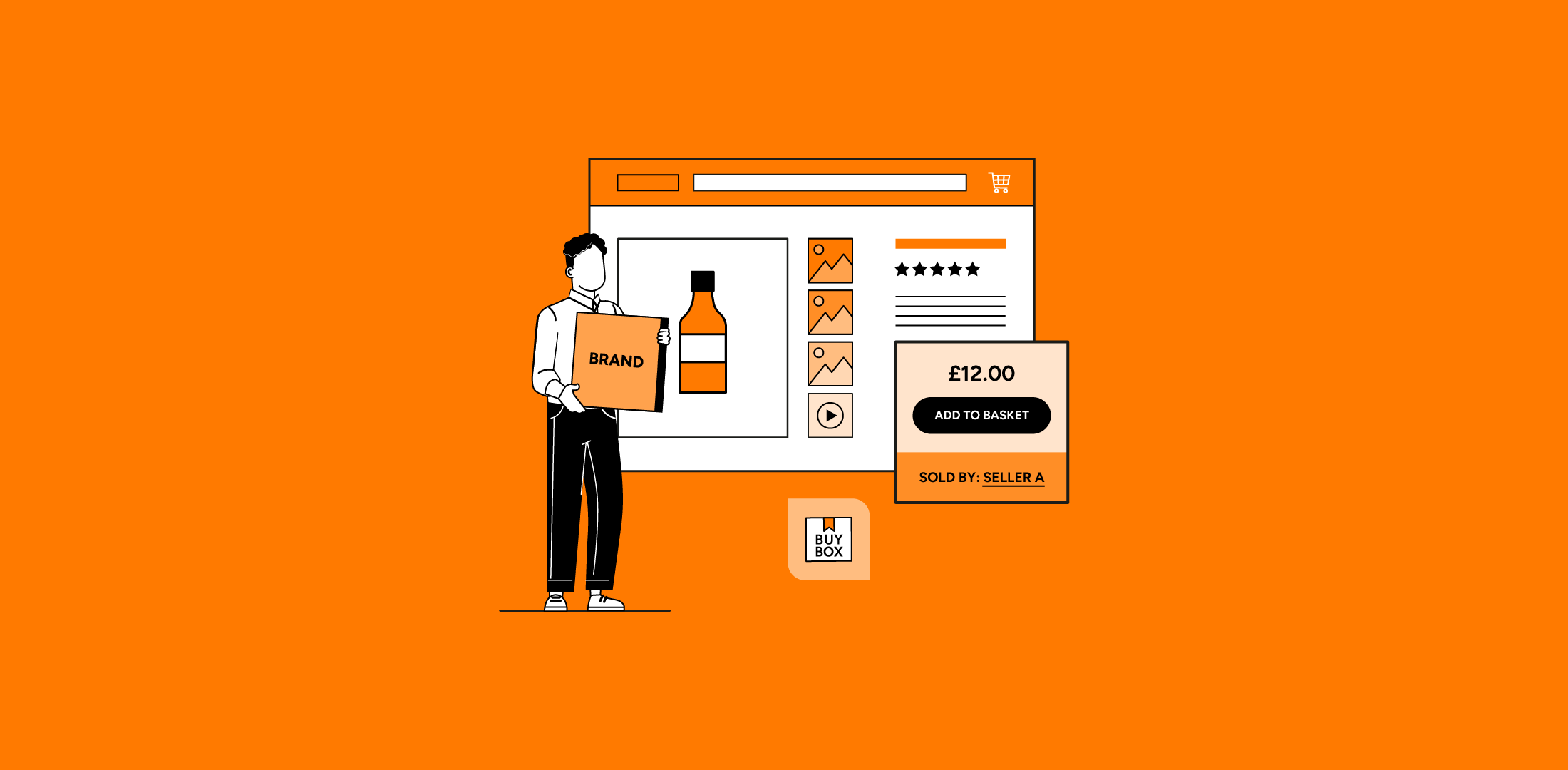
On a product page with more than one seller, one offer gets the Add to Basket button. Amazon's official name for it is the Featured Offer. The industry still calls it the Buy Box. The seller holding it takes nearly every sale on the page. On many brand listings, it is held by a third-party reseller.
In short: the Buy Box decides most of what sells on Amazon. The UK Competition and Markets Authority, working from Amazon's own data, found the Featured Offer accounted for over 80% of the value of sales on the UK marketplace. Amazon awards it continuously, weighing price, delivery, availability and seller performance, so a listing can change hands several times in a day. Brands usually lose it to third-party sellers through diverted stock and price undercutting rather than anything on the page itself. Winning it back starts with seeing exactly who holds it, when, and at what price.
Table of Contents
- What is the Buy Box, and why does it decide the sale?
- How does Amazon choose the Featured Offer?
- Why do brands lose the Buy Box to third-party sellers?
- What does losing the Buy Box actually cost?
- What this means for your digital shelf strategy
What is the Buy Box, and why does it decide the sale?
More than one seller can list the same product on Amazon. Amazon reports that over 60% of sales in its store come from independent sellers, so on a listing with any volume, competing offers are the norm rather than the exception. The page shows one product. Behind it sits a queue of sellers at different prices.
The Buy Box resolves that queue. One offer is placed in the purchase area with the Add to Basket and Buy Now buttons. The rest are folded away under the page's other buying options, a link few shoppers open. In its 2022 decision on Amazon's marketplace, the European Commission found that the large majority of consumers view only the offer in the Buy Box and buy that offer.
The UK Competition and Markets Authority, drawing on Amazon's own figures, found the Featured Offer accounted for over 80% of the value of sales on the UK marketplace. The widely repeated claim that exactly 82% of sales go through the Buy Box has no traceable Amazon source, which is why we use the regulator's figure instead.
Two further mechanics matter. The award is not permanent: Amazon re-evaluates the competing offers continuously, so a listing can change hands several times in a day, and the useful measure is your share of the Buy Box over time rather than a snapshot. And if no offer meets Amazon's bar on price, the Buy Box can be suppressed entirely, leaving a page with no purchase button and a See All Buying Options link in its place.

Whoever holds the Buy Box holds the sale, and on a contested listing that can change by the hour.
How does Amazon choose the Featured Offer?
Amazon doesn't publish a formula. It describes the factors: the landed price of the offer including delivery, the speed and reliability of the delivery promise, whether the item is in stock, and the seller's performance record on measures such as order defects, cancellations and late shipments. The weighting between them varies by category and price point. Price is the lever that moves most often, which is why the Buy Box behaves like a live auction rather than a ranking.
An offer that is out of stock can't win, which drives a common pattern: a brand's own offer goes unavailable, a third-party seller becomes the only eligible offer, and the Buy Box changes hands by default rather than by competition.
The Buy Box also works differently in Europe from the version described in most US-written guides. Following a European Commission decision in December 2022, Amazon must apply non-discriminatory criteria when selecting the Featured Offer in the European Economic Area, and must display a second competing offer beneath it where a rival offer differs sufficiently on price or delivery. In the UK, commitments accepted by the Competition and Markets Authority in 2023 mean that since May 2024, Prime eligibility is no longer a criterion for winning the Featured Offer. Playbooks built on the US experience transfer imperfectly.
Why do brands lose the Buy Box to third-party sellers?
Rarely because of anything visible on the page. The content, the imagery and the reviews belong to the listing, not to the offer, so every seller competes with the brand's own assets behind them. The contest is decided on price and availability, and the sellers who win it against a brand usually got their stock from the brand's own supply chain.
Diverted stock is the most common route. Genuine product leaks out of authorised channels: a distributor over-orders and sells the surplus on, stock crosses borders to arbitrage price differences between markets, or goods intended for a professional channel end up online. Beauty shows the pattern at its sharpest. The products carry high value in small parcels, demand for the brand name is strong, and selective and salon distribution creates many points where stock can leak. A reseller who acquired diverted product at distributor terms can undercut the brand's intended price by 20% or more and still make margin. Because the product is genuine, counterfeit protections do not catch it.
One leaked price then travels. Repricing software watches contested listings and adjusts within minutes, so a single low offer can pull the whole listing down. Where Amazon is the brand's first-party retailer, sustained price matching can erode Amazon's own margin until the item is flagged internally as unprofitable. Amazon's shorthand for these items, CRaP, stands for Can't Realise a Profit. At that point Amazon may stop ordering the product or suppress its own offer, the brand's first-party presence fades, and a third-party seller inherits the Buy Box.

The instinctive response is to force resellers' prices back up. In Europe that instinct is dangerous. Dictating or restricting a reseller's resale price is resale price maintenance, unlawful under EU and UK competition law, and enforcement is active: in October 2025 the European Commission fined Gucci, Chloé and Loewe a combined €157 million for restricting their resellers' pricing freedom. What remains lawful is monitoring resale prices, tracing where leaked stock originated, and, for brands operating genuine selective distribution, restricting authorised resellers from selling through third-party marketplaces, a route the Court of Justice of the EU upheld in its Coty judgment. Tightening distribution takes longer than a pricing demand, but it is lawful and it fixes the leak rather than the symptom. Take legal advice before acting.
The listing's traffic, content and reviews can all belong to the brand while the transaction goes to a seller it has not heard of.
What does losing the Buy Box actually cost?
The lost transaction is the visible part. Three less visible costs sit behind it.
The first is advertising. Amazon's Sponsored Products ads display only while the advertised product holds the Featured Offer. Lose the Buy Box and campaigns on that listing stop serving, with no alert. The listing's organic traffic keeps converting, through another seller's offer, while the brand's paid activity waits for a position it no longer holds. Retail media reviews rarely connect a dip in ad-attributed sales to a Buy Box loss weeks earlier.

The second is the pricing signal. The Buy Box price is the reference price for the product: the price shoppers see, and the price other retailers benchmark against. When a diverted-stock seller holds the box at 25% below intended retail, that becomes the product's public price, with consequences for every other retailer conversation the brand is having.
The third is the customer experience. The shopper believes they bought from the brand. Fulfilment, returns and product condition now sit with a seller the brand has no relationship with, and any disappointment lands on the listing's reviews, which the brand keeps.
AI shopping raises the stakes further. Alexa for Shopping (formerly Rufus), Amazon's shopping assistant, can act on a shopper's behalf, from adding items to the basket to completing a purchase when a target price is met. Amazon has not published how the assistant chooses between sellers' offers, but an assistant completes a purchase without presenting a queue of alternatives. As buying becomes more assisted, the selected offer wins with even less human comparison than today.
What this means for your digital shelf strategy
A brand that knows it is losing the Buy Box, but not to whom, when, or at what price, can't choose between the responses above, because each answers a different cause. An unauthorised seller at a deep discount points to a distribution leak. A first-party offer that keeps going unavailable points to supply or forecasting. A suppressed Buy Box points to pricing. Those facts change by the hour, so weekly snapshots miss most of them.
The eStore platform makes the Buy Box measurable. It monitors who holds the Buy Box on each listing, tracks your share of it over time, records the date it was first lost, identifies the third-party sellers offering your products, and checks price and availability on Amazon listings multiple times a day to keep pace with repricing. That turns "we are losing the Buy Box" into "this seller took it on this date at this price", which is the sentence a commercial team can act on.
The same discipline extends beyond Amazon. Comparable featured-offer mechanics run wherever multiple sellers share a listing, including bol.com, Kaufland, Allegro and Cdiscount, so a brand selling across European marketplaces has more than one Buy Box to watch.
Doing this across retailers and markets depends on accurate, current data. The eStore platform delivers 99.7%+ data accuracy across more than 3,000 retailer websites in over 70 markets, so the picture you act on matches what shoppers currently see.
For a wider look at how the platform monitors availability, pricing, content and search across the digital shelf, see our digital shelf analytics platform overview.
Key Takeaways
- The Buy Box, officially the Featured Offer, is the purchase area on an Amazon listing. The UK Competition and Markets Authority found it accounted for over 80% of the value of sales on the UK marketplace, using Amazon's own data.
- Amazon awards it continuously on price, delivery, availability and seller performance. There's no published formula, and share over time is the meaningful measure, not a snapshot.
- Brands usually lose the Buy Box to third-party sellers through diverted stock and price undercutting, not through anything on the page. Beauty is especially exposed because genuine product leaks easily from selective and professional channels.
- Losing it costs more than the sale. Sponsored Products ads stop serving, the leaked price becomes the product's public reference price, and the customer experience passes to an unknown seller while the reviews stay on the brand's listing.
- In Europe, forcing resellers' prices up is unlawful resale price maintenance. Monitoring, tracing leaks and tightening distribution are the lawful levers, and all of them start with knowing who holds the Buy Box, when, and at what price.
Frequently Asked Questions
What is the Amazon Buy Box?
The Buy Box is the purchase area on an Amazon product page, holding the Add to Basket and Buy Now buttons. When several sellers list the same product, Amazon selects one offer to feature there. Amazon's official name for it is the Featured Offer. Other offers are folded away under the page's buying options, and regulators in the UK and EU have found the featured position takes the large majority of the listing's sales.
How does Amazon decide who wins the Buy Box?
Amazon doesn't publish a formula. It weighs the landed price including delivery, the delivery promise, stock availability and the seller's performance record, with weightings that vary by category. The decision is re-evaluated continuously, so the Buy Box can change hands several times a day. In the European Economic Area, Amazon must apply non-discriminatory criteria and display a second competing offer where one differs sufficiently, and in the UK, Prime eligibility has not been a selection criterion since May 2024.
Why is a third-party seller winning the Buy Box on my product?
Usually price, and usually the price of stock that left your authorised channels. Diverted genuine product lets resellers undercut your intended price and still make margin. Availability is the other common cause: if your own offer goes out of stock, an eligible third-party seller wins by default. The diagnosis matters because the responses differ, so the first step is identifying the seller, the price and the dates.
Can I force resellers to raise their prices?
Not in Europe. Setting or restricting a reseller's resale price is resale price maintenance, unlawful under EU and UK competition law. In October 2025 the European Commission fined Gucci, Chloé and Loewe a combined €157 million for it. Brands can lawfully monitor resale prices, trace where leaked stock originated and, within a genuine selective distribution system, restrict authorised resellers from selling through third-party marketplaces. Take legal advice before acting.
Does the Buy Box exist outside Amazon?
Yes. Comparable featured-offer mechanics run on marketplaces where several sellers share a listing, including bol.com, Kaufland, Allegro and Cdiscount. The names and criteria differ, but the structure is the same: one offer takes the prominent position, and the rest compete for it on price, delivery and performance.
See Who Is Winning Your Buy Box
If you lead e-commerce or category for a consumer brand and want a clear picture of who holds the Buy Box on your listings, when it changes hands and at what price, we'd welcome the conversation. Speak to our team for a detailed walkthrough of Buy Box, third-party seller and pricing monitoring across your retailers and markets.
References and Further Reading
- Competition and Markets Authority, decision to accept binding commitments from Amazon, November 2023 - Featured Offer share of UK marketplace sales value and the UK commitments, including the Prime eligibility change
- European Commission press release, commitments by Amazon on marketplace seller data, Buy Box and Prime, December 2022 - non-discriminatory Featured Offer criteria and the second competing offer in the European Economic Area
- European Commission press release, fines for Gucci, Chloé and Loewe for anticompetitive pricing practices, October 2025 - resale price maintenance enforcement
- Amazon, small and medium-sized businesses - share of sales from independent sellers
- Court of Justice of the EU, Coty Germany GmbH v Parfümerie Akzente GmbH, Case C-230/16 - marketplace sales restrictions within selective distribution