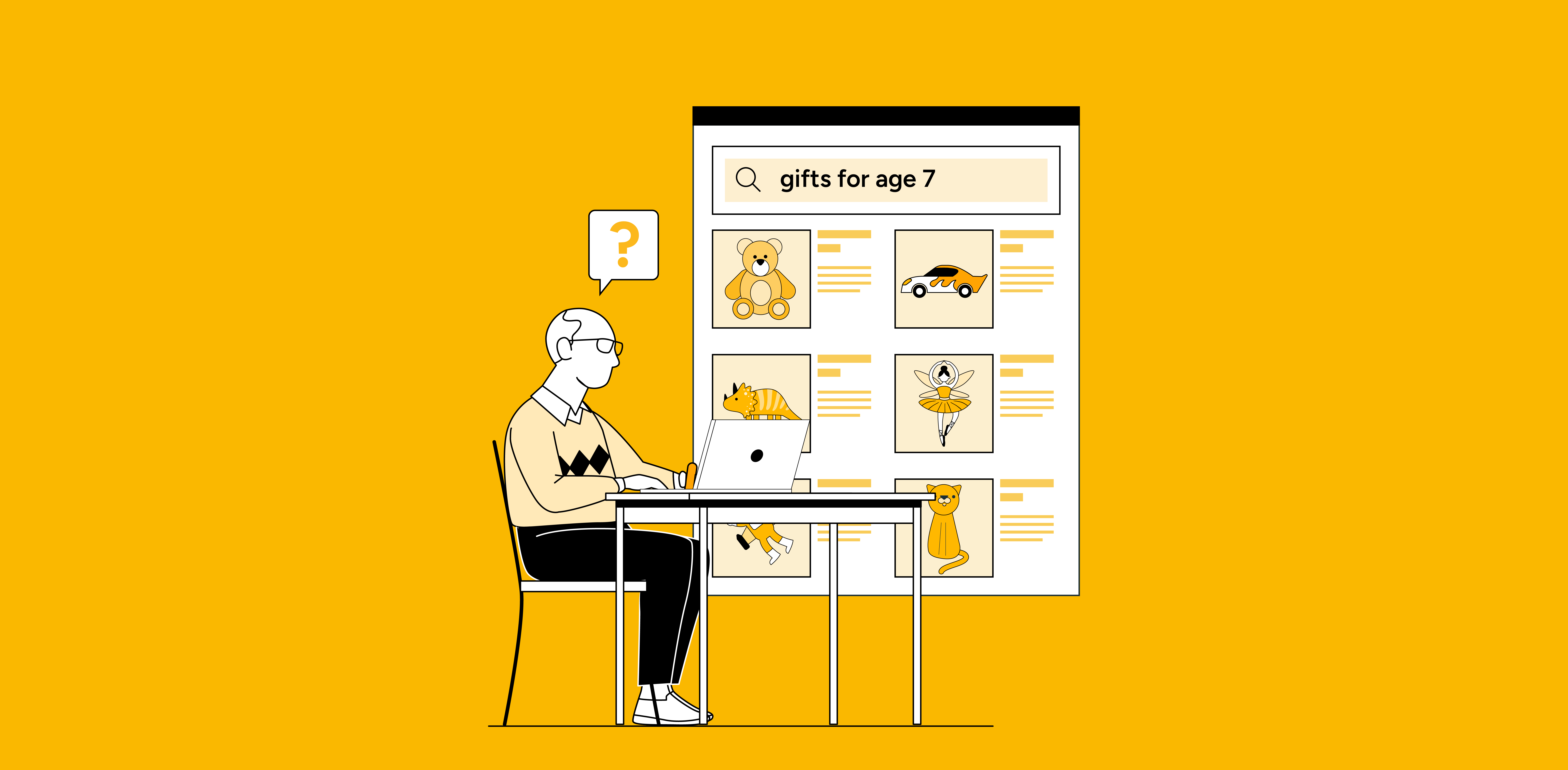
Most categories are bought by people who know them. Toys are different. A large share of toy purchases are made by someone shopping for someone else: a grandparent, an aunt, a family friend, a parent working from a wish list. That shopper often does not know the brands, the age ranges or the price of a good gift. They are deciding anyway. On the digital shelf, the page has to do the knowing for them.
In short: Toys and games are a gift category. Most toys are bought for a child under 10 by an adult who is not the person who will play with them. Gift buyers reach retailer sites through generic searches and age filters rather than brand terms, so the searches that actually decide the sale often go untracked. Winning the gift buyer means being visible for the generic terms they type, and building pages that answer the questions they cannot answer themselves: is this right for the age, what does it do, and is it any good. With UK Christmas sales at 23% of the annual market, the cost of getting this wrong is concentrated into a few weeks.
Table of Contents
- Who is actually buying toys online?
- Why doesn't the gift buyer search for your brand?
- What does the page have to do when the shopper cannot judge the product?
- What does Q4 do to the cost of a gap?
- What this means for your digital shelf strategy
Who is actually buying toys online?
Very often, not the person the toy is for. The buying group is wide: parents, grandparents, aunts, uncles, godparents and family friends, many of them shopping outside their own knowledge of the category. Circana's 2026 Global Toy Report puts recipients under 10 at more than 65% of global toy sales. And gift buying is an online behaviour: in a 2024 UK survey, 73% of shoppers said they buy Christmas gifts in online stores.
Even parents are often guessing. In a 2022 survey conducted by OnePoll for The Toy Association, 29% of US parents said not knowing what to get was a problem when holiday shopping for their children. They may be working from a wish list they half understand, or from a child's description of something a friend has.

The industry's fastest-growing segment runs the other way. Circana reports recipients aged 15 and over now account for nearly 20% of global toy sales, adults and teens buying largely for themselves, and that buyer needs no help knowing what to want. But the majority of the market still works on the older pattern: bought by one person, played with by another. In most consumer categories the buyer is the user or shops for the household. They know the brands and roughly what things cost. The gift buyer arrives with none of that. What they have is a child's age, a budget, and an occasion with a date on it.
The shopper who decides what a child receives at Christmas may never have typed your brand name.
Why doesn't the gift buyer search for your brand?
Because they often do not know it. A shopper who does not know the category does not start with a brand term. They type what they do know: "gifts for a 7 year old", "toys for toddlers", "board games for families". On retailer sites, they reach for the age filter and the price band instead of the search bar.
The same request is starting to be made in a different form. On Amazon, Alexa for Shopping (formerly Rufus) takes it as a sentence rather than a keyword: gifts for a 10 year old who likes football, under £10. Same shopper, same three inputs, asked out loud instead of assembled from filters. What comes back is a short set of recommendations rather than a page of results, and those recommendations are built from retailer content: titles, attributes, descriptions and reviews. Wrong age attribution or a thin description stops being a ranking problem at that point and becomes a reason not to be in the set at all.
Brand-side measurement tends to look elsewhere. Search tracking usually covers brand terms and hero product terms, because those are the terms the brand knows to check. Rankings on "gifts for a 7 year old" at each retailer sit outside that list. So a brand can hold strong positions on every term it tracks and still be absent from the searches where the gift buyer actually is.
The retailer's own taxonomy matters just as much. If a product carries the wrong age attribution in a retailer's data, it does not appear when the shopper filters to the right age. The listing is live, the content is complete, and the product is invisible to its buyer anyway.
The eStore platform tracks search visibility per retailer on the terms you choose, not just your brand terms. That makes generic and occasion terms measurable: where you rank, who ranks above you, and how that changes week by week as the season builds. The same measurement extends to AI search on retailer sites, including Alexa for Shopping, where we track the questions worth tracking in your category and measure whether your products appear in the answers.
What does the page have to do when the shopper cannot judge the product?
It has to replace the expertise the shopper does not have. A parent in the category can look at a product and place it: the right age, the play pattern, whether it will hold attention past Boxing Day. A gift buyer cannot. The page answers three questions for them, or loses them.
Is it right for the age? Age grading needs to be prominent, correct and consistent between your content and the retailer's filters. What does it actually do? Imagery and video that show the toy in use do more here than any description. Is it any good? Reviews carry unusual weight here. A shopper who cannot judge the product borrows the judgement of people who could.

Gaps that a knowledgeable buyer would shop past will stop a gift buyer entirely. A thin description or a single pack shot leaves their questions unanswered, and an unanswered question next to a search results page full of alternatives is usually the end of the visit.
The eStore platform scores every page against a content target set for each retailer, covering the imagery, copy and key fields the gift buyer depends on. It monitors ratings and reviews across your retail estate. Where content needs improving at scale, Content Optimizer brings your brand targets, category benchmarks and retailer field requirements together in one place.
What does Q4 do to the cost of a gap?
It multiplies it. Circana puts UK Christmas toy sales at £0.9 billion, 23% of the annual market, and reported sales up 51% in the single week before Christmas 2024. A content gap in April costs some sales. The same gap in November costs a multiple of them.
Demand also concentrates onto specific products. Retailer and press top toy lists funnel the season's attention onto a small set of hero SKUs. When a list lands, the named products see demand few categories ever experience. A page that is incomplete that week, or a product that goes out of stock in early December, is not just losing a week of sales, it's potentially losing the year. And the same OnePoll survey found 42% of parents ran into product availability problems, so availability is already part of what shoppers expect to go wrong at Christmas.

Daily is the baseline. The eStore platform checks availability and price across your retailers every day, with alerts as problems open. Through peak, that frequency goes up: for some brands we check availability and buy box every 15 minutes on the products carrying the season. In October to December, that is the difference between catching a stockout on a hero SKU within the hour and finding it in the January review.
In a category where 23% of the year happens at Christmas, a December stockout is not a lost week.
What this means for your digital shelf strategy
The toy buyer is often a guest in the category. They search in generic terms, filter by age, and rely on the page to tell them what a knowledgeable buyer would already know. Winning them means measuring what they see: visibility on the terms they type, content that answers their questions, reviews that lend them judgement, and availability that holds through the weeks when it matters most.
Doing that across retailers and markets depends on accurate, current data. The eStore platform delivers 99.7% data accuracy across more than 3,000 retailer websites in over 70 markets. You see the season the way the gift buyer sees it, while there is still time to act.
For a wider look at how the platform monitors content, availability, search visibility and pricing across the digital shelf, see our digital shelf analytics platform overview: https://estorebrands.com/digital-shelf-analytics
Key Takeaways
- Toys are a gift category. Circana's 2026 Global Toy Report puts recipients under 10 at more than 65% of global toy sales, bought for them by adults, and a 2022 OnePoll survey for The Toy Association found 29% of US parents struggle to know what to buy.
- Gift buyers reach retailers through generic searches and age filters rather than brand terms, and the same requests are now being put as questions to AI search on retailer sites, so the searches that decide the sale often sit outside what brands measure.
- The page has to replace the shopper's missing expertise: prominent and correct age grading, imagery that shows the toy in use, and reviews that lend the buyer judgement.
- UK Christmas sales are 23% of the annual toy market by Circana's figures, and top toy lists concentrate that demand onto hero SKUs, so a December gap on the wrong product costs the year.
- The eStore platform tracks search visibility on the terms you choose, including AI search on retailer sites, scores content against retailer-specific targets, monitors reviews, and checks availability and price daily, with higher-frequency checks through peak, at 99.7% data accuracy across more than 3,000 retailer websites.
Frequently Asked Questions
Who buys toys online?
Mostly not the person the toy is for. Circana's 2026 Global Toy Report puts recipients under 10 at more than 65% of global toy sales, with those purchases made by parents, grandparents and other gift buyers. A 2022 OnePoll survey for The Toy Association found 29% of US parents struggle with not knowing what to get, and buyers beyond the household typically know less. Recipients aged 15 and over, largely buying for themselves, are the fastest-growing segment at nearly 20% of sales.
Why do generic search terms matter more in toys than in other categories?
Because the gift buyer often does not know the brands. They search by age, occasion and budget: "gifts for a 7 year old" rather than a brand name. Brands that only track brand and hero product terms can rank well on everything they measure and still be absent where the gift buyer is looking. The same request is increasingly put as a question to AI search on retailer sites, including Alexa for Shopping on Amazon, where the answer comes back as a short set of recommendations rather than a page of results. Being left out of that set is a harder problem to spot than ranking low within it.
What should a toy product page do for a gift buyer?
Answer the three questions the buyer cannot answer alone. Is it right for the age: prominent, correct age grading that matches the retailer's filters. What does it do: imagery and video showing the toy in use. Is it any good: healthy, visible reviews, because the buyer borrows the judgement of people who know the product.
Why is Q4 readiness different in toys?
Circana puts UK Christmas sales at 23% of the annual toy market, with sales up 51% in the single week before Christmas 2024. Top toy lists concentrate that demand onto a small set of hero SKUs. A content gap or stockout on the wrong product in December costs a share of the year rather than a share of the week.
Win the Shopper Who Doesn't Know Your Category
If you lead eCommerce or category for a toy or games brand and want to see your season the way the gift buyer will, we would welcome the chance to walk through how it works. Speak to our team for a detailed look at search, content and availability monitoring across your retailers and markets:
References and Further Reading
- Circana, "Building up to Christmas: UK toy market grows to £3.9bn" - UK market size, Christmas share of annual sales and the pre-Christmas sales surge
- Circana, "Global Toy Market Hits $123B: Play Expands Across Ages & Emerging Markets" - the 2026 Global Toy Report: recipient age splits and market size
- Statista, "Purchase locations for Christmas gifts in the UK" - 2024 survey on online gift buying
- OnePoll survey conducted for The Toy Association, 2022 - US parents on gift uncertainty and product availability problems