



Christmas shoppers don't all shop at the same time. Some start searching online in September, gift sets sell best in mid-November, and plenty of people still leave everything until the final week. Here's what that means for suppliers planning the season.
Most Christmas plans work back from December, and for a lot of products that's still where the biggest weeks are. Online, though, the shop starts well before then. Searches for cards, wrapping paper, advent calendars and selection boxes begin in mid-September and pick up through October. Gift sets start selling in early October and are at their busiest in mid-November, ahead of Black Friday, which falls on 27 November this year.
We see this in the daily ASDA.com e-commerce data we work with through ASDA Xpert. Products don't all follow the same pattern. Some climb steadily to a December peak. Others sell in two separate bursts. Advent calendars are different again, because they have to be bought before December even starts. Then a large group of shoppers arrives in the last few weeks, buying late and usually in a hurry, so a good Christmas plan needs room for them too.
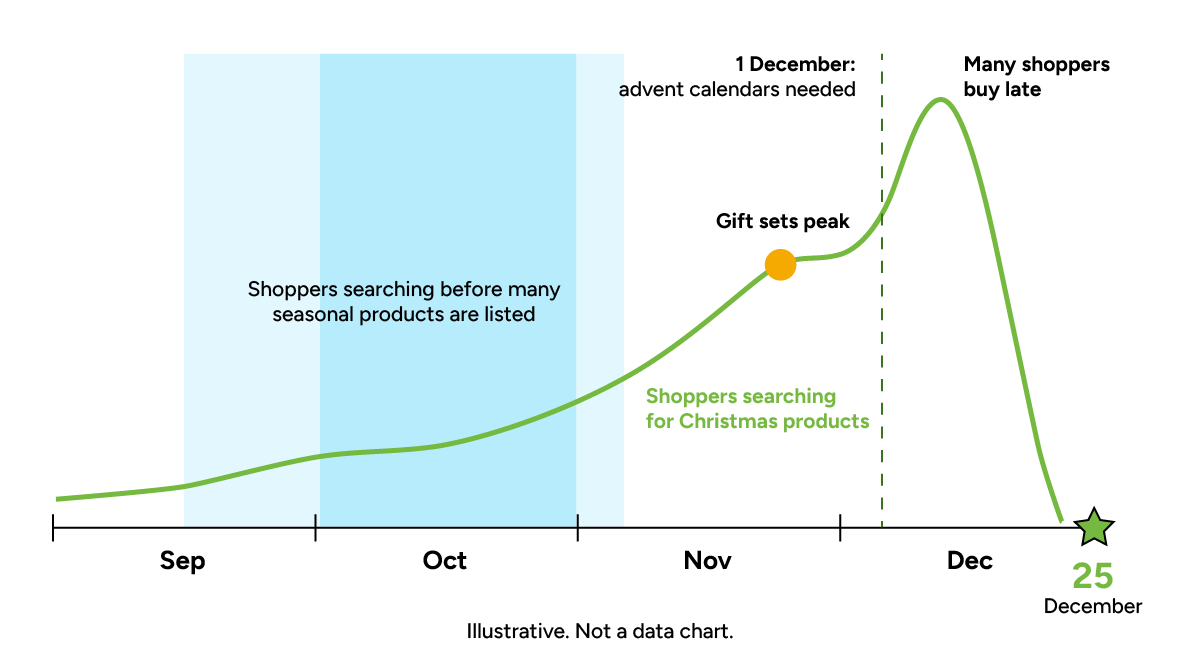
Search interest starts building in September. Gift sets peak in mid-November. December stays busy, with many shoppers buying late. Illustrative. Not a data chart.
Five things we see, and what to do about each

1. Shoppers search for Christmas products before many of them are listed
What happens. Searches for Christmas cards and Christmas wrapping paper begin in mid-September and keep growing through October. During those weeks many seasonal products aren't listed online yet, so people who search are shown the nearest everyday alternative.
Why. Some shoppers like to get cards and wrap sorted early, so there's time to write and post them. If the seasonal range isn't there yet, the results fill up with whatever is closest, such as children's stationery or everyday gift bags. The shopper either settles for one of those or leaves without buying.
What to do. Find out when your seasonal products go live online, and ask for the earliest date the range plan allows. Get your product content, images and search terms ready before then, so your products show up from day one. Your sales figures will show little or nothing for those early weeks, but the searches show some demand was there, so take that into next year's range conversations.

2. Gift sets peak in mid-November, before Black Friday week
What happens. Gift sets start selling in early October and peak in mid-November. Sales ease off after that, then pick up a little in the week or two before Christmas. People keep searching for gift sets well into December, but they spend less on each gift.
Why. A present for a particular person is usually planned, so a lot of them get bought early. Some households also spread the cost of Christmas over several weeks. December gift shoppers are more likely to be picking up stocking fillers, small extras and last-minute top-ups.
What to do. Have your gift sets in stock, well described and easy to find through the first half of November, especially the higher-value ones. Keep going after that. In December, make sure your lower-priced items come up when late shoppers search for gifts or stocking fillers.

3. Advent calendars have a fixed deadline, and stock is tightest just before it
What happens. Advent calendars sell from early September and build steeply through November, with the busiest week right at the end of the month. That's also when substitutions jump, along with orders where the calendar can't be picked at all. The pressure carries on into the first few days of December.
Why. A calendar needs to be in the house by 1 December. Lots of people leave it to the last moment, so demand piles into a handful of days that a normal stock plan isn't built for. Once December starts, searches fall away fast and the calendars still on sale go for much lower prices.
What to do. Plan stock for the last week of November rather than for an average week. Check availability daily that week and know which of your calendars are most likely to run out. Find out what shoppers receive instead when yours is substituted, so you can see whether that sale stays with you.

4. Chocolate sharing pouches and tubs are bought in two waves
What happens. Christmas chocolate pouches and tubs sell in two bursts: one in early to mid-November, then a bigger one in mid-December, with a lull in between. Boxed chocolates and novelty lines behave differently. They build steadily to a single December peak.
Why. The November burst is people stocking up. They buy chocolate that will keep, often while it's on promotion, and put it in the cupboard for the holidays. Not all of it makes it that far, so plenty of them buy again nearer the day.
What to do. Plan for two peaks. The retailer sets the promotional windows, so put your effort into what you can control: stock, content and search, ready for early November and again for mid-December. A dip in late November is the gap between the two waves, so don't read it as the season ending.

5. Stock pressure on festive lines rises as Christmas gets closer
What happens. Across festive confectionery, substitutions and items that can't be picked become more common as December goes on. They peak in the last fortnight before Christmas.
Why. Demand in those weeks is far higher than normal, and there's not much time left to restock. Someone shopping for Christmas Day usually can't wait for a product to come back, so they take whatever alternative is there.
What to do. The early weeks are a chance to win the shoppers who buy ahead, while stock is easier to manage. For the December rush, plan stock around the peak weeks, check availability every day and get to know your substitution patterns beforehand. If your main line sells out, whether the shopper stays with your brand depends on what else of yours is in stock and easy to find.
All five have a specific, current answer for your own products, and those answers sit inside ASDA Xpert.
See the Christmas build through your own products
ASDA Xpert gives suppliers direct access to ASDA.com e-commerce data for their own products: views, conversion, availability, substitutions and search performance, updated weekly with data down to daily level.
This article draws on eStoreBrands' ongoing analysis of ASDA.com e-commerce data, which is made available to ASDA suppliers through ASDA Xpert. Observations are directional; no performance data, growth figures or category outcomes are disclosed. Supplier-specific findings are shared with the relevant supplier through the platform.